-
![]()
Southeast United States Food Chain
-
![]()
Sub-tropical Ocean Food Chain
-
![]()
Kenya and Tanzania Food Chain
-
![]()
North America Food Chain


Food Chain Reports
-
In a food chain, there are different trophic levels. A producer is an organism that makes its own food, generally through photosynthesis. A consumer is an organism, most likely an animal that can’t produce its own food and has to consume, or eat other living organisms to gain energy and nutrients. This food chain is located in the Atlantic ocean. The bottom of my food chain is the phytoplankton, then it is the sea butterfly, next is tuna, and at the top of the food chain is the bottlenose dolphin.
Phytoplankton are microscopic organisms. Phyto- means “plant” and plankton derives from the Greek word ‘planktos’ meaning “wanderer”. Phytoplankton are less than one micrometer long. That is as small as one one-hundredth the width of a human hair! They are producers, which means they use photosynthesis. Photosynthesis is when a plant uses H2O, or water, CO2, or carbon dioxide and sunlight to make oxygen and energy in the form of glucose, a sugar to feed themselves. Like land plants, they need nitrate, phosphate, silicate, and calcium to build cellular structure. Phytoplankton live in most bodies of water in the world, like the oceans, rivers and lakes. They only live a few days to a week because they are built for rapid reproduction rather than a long life. Phytoplankton have predators, like zooplankton, small fish, and sea butterflies.
Sea butterflies, also known as pteropods,( teh-ruh-paadz) got the name “sea butterfly” because of their elegant swimming style. It swims by using a pair of converted feet, or muscular feet which act like wings. Sea butterflies are protandrous hermaphrodites, which means they are born as males and become females later in life. Sea butterflies capture their prey by casting a web of mucus that traps their prey, like phytoplankton, dinoflagellates, and small zooplankton. They live about one to two years. Sea butterflies are consumers. They grow to about one centimeter long. Sea butterflies have thin shells made of argonite, an unstable form of calcium carbonate. The predators of the pteropods are sea angels and tuna.
Tuna belong to the scombridae family. Tuna are extremely fast. They have been spotted swimming up to 48 miles per hour. Tuna are consumers. Tuna are warm blooded. Warm blooded animals can regulate their body temperature. Tuna never stop swimming because they do obligate ram ventilation. Obligate ram ventilation is a special breathing method that requires them to continually swim with their mouths open to force oxygenated water over their gills. They suffocate if they don’t swim. Tuna can weigh 40 to 500 lbs. Tunas predators are killer whales, also known as orca, sharks and bottlenose dolphins.
Bottlenose dolphins are marine mammals. They are consumers. They eat tuna, crustaceans, and squid. Bottlenose dolphins use echolocation and unique signature whistles to communicate with other dolphins and hunt fish. Echolocation works by sound waves bouncing off objects, and returning. Echoes are interpreted by the brain to determine an object's distance, size, speed, and shape. They are very smart because of their advanced communicative skills and high intelligence. Bottlenose dolphins live about 40 to 60 years. They are thirteen feet long and often live in groups, called pods. They have extremely sharp teeth like razor blades but they do not use them for chewing. Instead they use them for catching slippery prey.
Food chains are very important. If one animal went extinct that would start a chain reaction because Animals rely on each other to stay alive. Having all the animals in the food chain helps with population sizes.
-
All living things are part of something. In nature, plants and animals work together in a food chain. Some get eaten, some live their whole lives, and some are even captive.
In a food chain, plants and animals are separated into producers, consumers, and decomposers. These are the main trophic levels of a food chain. Producers make their own food, such as a plant that uses photosynthesis to create glucose. Then, there are the primary consumers, which are herbivores. They consume the producers. The next trophic level in a food chain are secondary consumers, they eat the primary consumers. There are tertiary consumers, which eat the secondary consumers. Finally, there is the very top predator, the apex predator, which can eat anything that they prefer to. The very last trophic level are the decomposers. The decomposers, well, decompose. They break down dead materials to make soil more nutritious for plants, for example, one of these decomposers are fungi. More plants grow, and the whole entire food chain starts again. For instance, a food chain can be a dandelion, snail, frog, crow, and a fox.
Dandelions are a part of the “Asteraceae ,” (As-tuh-ray-see-ee) family, some of its relatives are daisies, marigolds, chrysanthemums, zinnias, and dahlias, which are all producers. A dandelion's scientific name is “Taraxum Officinale,” (Ta-rah-suh-kum A-fish-uh-nah-lee), which can live almost everywhere. While dandelions are just doing their job of existing, some people hate them. The hatred is because they are truly invasive and spread like wild fire. Most people claim that they are weeds. They were brought by the pilgrims from Europe and Asia in the 1600s. While some people see them as weeds, other people admire them for their beauty. Yet, with people killing these “weeds”, it still disrupts the food chain. They’re taking away food from animals, like pollinators, but it disrupts primary consumers too.
While dandelions are admired and hated, they’re still a part of the food chain. Their germination, or seed growth, takes about five to ten days. Sprout growth takes about two to four weeks. Once they sprout, they grow their leaves and expand their roots. Then, they flower for one-two weeks. After dandelions flower, they grow the seeds in their head. The head closes and wilts, and each tiny floret, or flower within a flower, creates the pappus, the stage of a dandelion's life that you might know as a “wish”. They pass on new life, and scatter those florets and seeds for either days or weeks. Once the pappus gets blown away, they bury themselves underground for the winter, then the whole life cycle of that dandelion repeats again.
If that dandelion doesn’t live its full life, it might get eaten by a snail, a Copse snail to be exact. Copse snails normally eat every part of the dandelion, except for the bud. The scientific name for a copse snail is Arianta arbustorum (Ah-ree-ann-tah ar-boo-stor-um). They live in almost every ecosystem that has humidity, like woodlands for example. They are native to some of Europe, North America, and parts of Russia. These snails are normally black, and the average shell is normally brown. If you were to hold one, it would be about the size of an adult's palm. It takes about two to four years for a copse snail to mature, but overall, they live up to seventeen years. Since snails are extremely slow, they only move about seven to twelve meters a year! If the snail moves farther than that, they travel along water currents. If two snails are born about 50 meters away from each other, they are considered isolated. One of the most fascinating things about Copse snails is how they mate. When they mate, one of the snails will stick a chalky, needle-like dart, otherwise known as a “love dart”. The dart is covered in a snail's mucus, so that snail is basically transferring some of their DNA into the other so they have a better chance of producing eggs. If snails do mate, they will lay 20-50 eggs that are brown with yellow spots, and over three millimeters big.
While Copse snails are still part of many ecosystems, they are still part of some food chains. Their predators, or secondary consumers, include frogs, shrews, birds, salamanders, and sometimes Copse snails follow cannibalism.
If a Copse snail is eaten by a frog, it could be a wood frog. They are also known as Lithobates sylvaticus (Lih-thob-uh-teez sil-vat-ih-kus). Wood frogs are named “Wood frogs” because they look like wood. They also have a black mark across their eyes, also being known as the “masked frog”. They are about three inches long, with bumpy skin, and normally have a green or yellow belly. They’re native to North America and live in deciduous and coniferous forests with marshes and swamps. When it comes to mating, these frogs are the first ones to start. Wood frogs mate when they are about two years old. They begin once their mating ponds unfreeze. To attract the females, males make a quacking-like sound. The wood frog cannot see or smell the other frog, so once they get to each other they have to hug to make sure that they won’t be mating with another male. The method that they use to tell that they’re mating with the right frog, is that they know that females are bigger than the males because they have to carry a lot of eggs. They lay 1,000 to 3,000 eggs. The female lays them on some sort of stem or stick that floats on water. She also covers them in something like a green gel to camouflage the eggs. After two months, those eggs hatch, they start swimming around, and become tadpoles. To start out, they normally eat marine plants, like algae or decaying matter. Mature frogs eat snails, worms, slugs, and spiders. Once they hibernate, they do one of the most fascinating things an animal could do. Wood frogs bury themselves in a leaf litter and hibernate. They don’t hibernate like an average frog would. They create an anti-freeze substance that keeps them frozen for the whole winter. Their heart and lungs completely stop, but they’re still alive. The only thing they need to survive all winter is their blood cells. The substance they create even keeps their blood cells working in even negative 80 degrees. Wood frogs are the only frogs that can be found in the Arctic Circle. They get the name “frozen rock” because of the way they hibernate. Once the hibernating season is over, they still have to face their predators. They can get eaten by lots of dangerous animals, like birds, snapping turtles, coyotes, and racoons.
One predator a wood frog could be eaten by is a crow, or “Corvus brachyrhynchos” (Kor-vus brak-ee-rink-oss). They’re tertiary consumers. These birds are very adaptable and can live in any place with a source of food and trees. They don’t just live in nature, they also take advantage of man-made habitats. The one ecosystem that a crow prefers not to nest in is a desert. The majority of crows live in the forest because sometimes people make them very disturbed. If you deeply irritate a crow, they can recognize your face and come back to attack you. They can also bring their whole flock depending on how furious you make them. Crows eat seeds, nuts, fruit, aquatic animals, and nestling. In a man made forest-like habitat they would eat decaying plants, garbage, and also food people leave around. Deciduous trees are normally the type of trees that crows prefer to nest in instead of coniferous trees. Deciduous trees shed their leaves in the winter for more energy and coniferous trees keep them all year. If a crow does mate, their eggs will probably be the size of a chicken egg. Crows will be in their egg stage for about one to two weeks. When they hatch, they’ll be nestlings for three to six weeks. Finally, when they mature, they will be sixteen to twenty-one inches long, and their wingspan will be 34-40 inches. In the winter, crows will find roosts, like an old tree, roof top, or even a residential area. Roosts have more room than nests so they can fit lots of birds. Some of these roosts have been used for over 100 years! The fun fact about these roosts is that there will be 100-1,000,000 crows in one roost. Crows are one of the smartest birds and this has been proved by watching them adapt to civilization by using tools. They have also had a chance to get a big comeback because in the 1930s, they were hunted and eaten. This catastrophe started in Oklahoma because people weren’t very fond of crows. The people saw crows as birds that would steal their crops, not help wildlife. A man, Dr. T. W. Starlings needed to get through the great depression. He decided to host crow banquets and serve them as dinner with gravy. His one rule was that there would be three crows per person. The governor of Oklahoma liked this idea, so he created the “Steakhouse Crow Meat Lover’s, Association”. After that, all crow hunting clubs were completely dedicated to kill and eat any living thing that is corvid, or part of the family of crows. Eventually, some hunters believed that crow hunting was good to keep some of the other birds around. Thankfully, the crow eating trend faded away in the 1940s, but everyone still saw Dr. Stallings telling reporters that crows were tasty, and easy to hunt. One thing that Stallings was right that crows are easy to hunt for both humans and animals. Their wild predators are eagles, owls, wild cats, raccoons, and foxes.
For instance, that crow could be eaten by a red fox, or using their scientific name a Vulpes vulpes. These foxes are mostly red, with a long snout, with a gray or white belly, black feet, and pointed black tipped ears. They’re about three feet long, two feet tall, and weigh six to fifteen pounds. Red foxes are native to North America and Asia. They prefer to live in woodlands, meadows, deserts, tundras, mountains, and they also live in man-made areas, such as farmlands and forest-like neighborhoods. They are omnivorous eaters, which means they eat plants and animals, such as rodents, birds, amphibians, insects, fruit, garbage, and anything that’s available. They are solitary hunters and only hunt at dusk and dawn. When they store their food, they rarely forget where it is. If they do forget, they can always sniff it out because it is most likely in their territory. Red foxes' teeth aren’t strong enough to bite through much, so they wait for another animal to kill something. They don’t need to eat much, so they can always eat whatever is left from other animals. Overall, foxes are scavengers. Once they catch a scent in the breeze, they stop, listen, then follow the scent. Once their prey gets in sight, they slow down and get ready to pounce. They can also hear and smell their prey from underground or under the snow. Red foxes mate from January to February. The female, or the vixen, builds the den while the male, or the dog, brings food. While the dog is gone, the vixen will defend up to seven square miles of their own territory. The vixen gives birth to one to thirteen pups per litter. She gives birth to one litter per year in spring. The pups are born brown and gray and turn red within one to two months. They are also born blind. They leave the den and learn survival necessities when they are about a month old, but they don’t set off on their own until autumn. In total, they live up to three years in the wild and up to twelve years in captivity.
Out of a dandelion, copse snail, wood frog, crow, and a red fox, together they make up a pretty decent food chain. It makes every living thing work together. Food chains are some of the most revolutionary things to observe in all of nature.
-
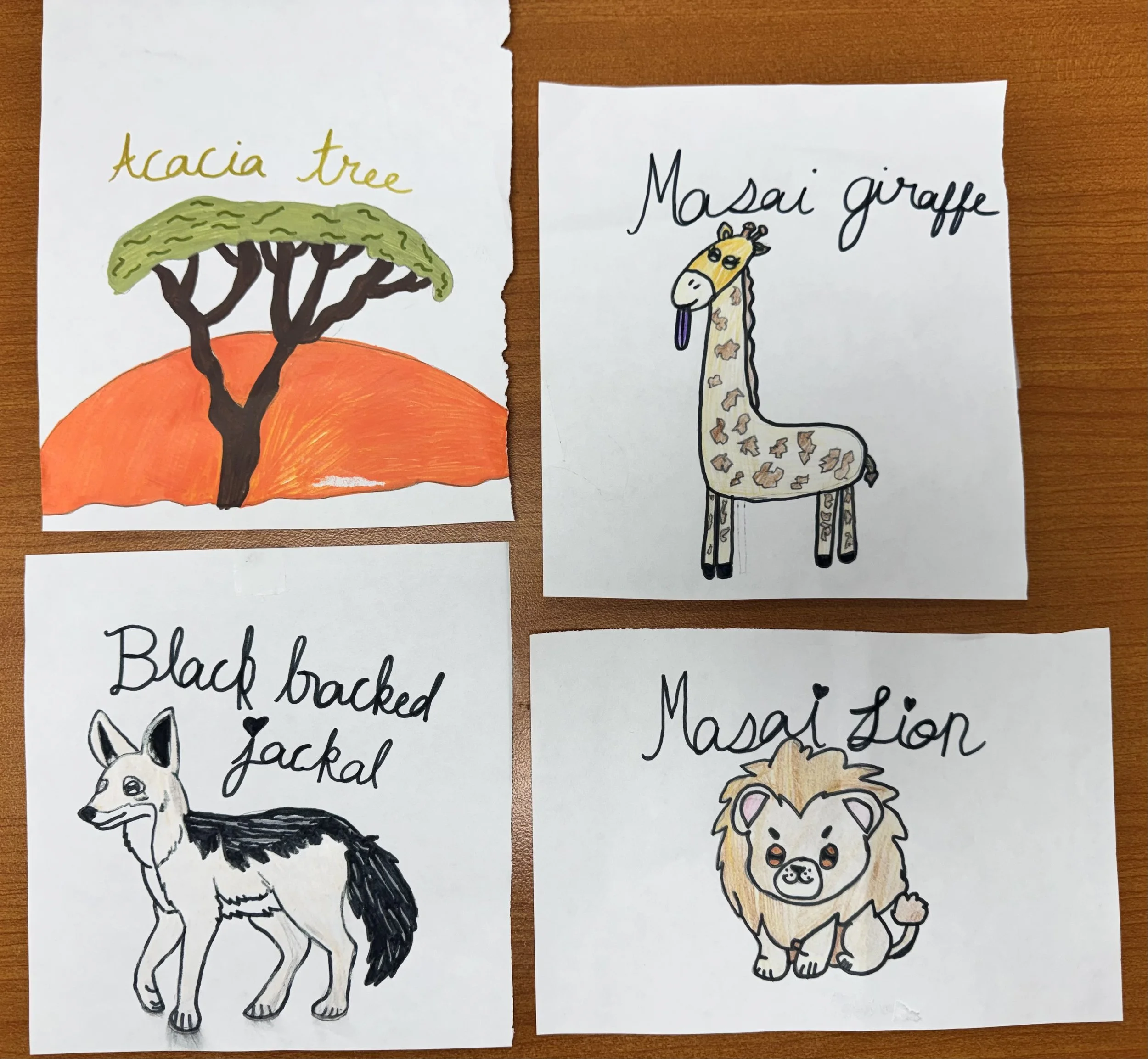
The food chain is made up of three main types of organisms. Producers, consumers and decomposers. Producers are often plants that produce food for herbivores; such as leaves, flowers or fruit. Consumers are animals that eat those plants, but some animals also eat other animals. The food chain that I will be talking about is located in Kenya and Tanzania. At the top of my food chain is the acacia tree and at the bottom of my food chain is the black backed jackal.
Acacia trees grow up to 25 feet tall and can live up to 70 years, and some can live over 200 years! There are over 1,084 different kinds of acacia trees all over the world! Acacia trees are producers. They use photosynthesis to create C6H12O6, or glucose, to use as energy. Photosynthesis is when a plant has plenty of sunlight and water. The rays of the sun are absorbed by the plant cells to help fuel photosynthesis. Photosynthesis causes the water molecules to split, separating the hydrogen and oxygen atoms. The oxygen then gets released into the atmosphere for us to breathe. Then, the hydrogen atoms combine with carbon dioxide to make sugar, which the plant can use as food. Acacia tree seeds take around one to three weeks to germinate, but in bad conditions it could take six to seven weeks. They can be found in the African savanna, East Africa, Australia, Arizona, California, and Texas. Some acacia tree sap and leaves are used for modern day medicine to help sore throats, burns, and reduce skin inflammation. The predators of the acacia tree include beetles, who eat the bark, elephants, who eat the leaves, goats who eat the seed pods, impala, who eat the flowers, and Masai giraffes who eat the leaves and flowers.
Masai giraffes are consumers. They eat acacia leaves, twigs, fruit, bark, and flowers. A female masai giraffe’s lifespan is about nineteen and a half years, but males only live thirteen and a half years, due to necking. Necking is when male giraffes swing their 40 foot-long necks at each other to assert dominance. Masai giraffes are endangered. They live in grasslands, Kenya, Tanzania, and East Africa. They have spots that look like oak leaves and they are also the tallest land mammal in the world at a whopping sixteen to eighteen feet. Masai giraffes only sleep five to thirty minutes a day, only taking one to two minute naps to avoid being ambushed by predators. Masai giraffes have 20 inch, dark purple, sandpaper like tongues that help them eat 75 pounds of food a day. They can also make noises such as moos, hissing, roaring, and whistling. The predators of a Masai giraffe are spotted hyenas, leopards, African wild dogs, poachers, and Masai lions.
Masai lions are apex consumers. They eat blue wildebeest, zebra, American buffalo, eland, and Masai giraffes. Females can live fifteen to sixteen years, but males only live ten to twelve years due to fighting with rival lions. Their predators are spotted hyenas, rival lions, and poachers. Masai lions can be found in tropical grasslands, savanna plains, woodlands of East Africa, Kenya, and Tanzania. Baby Masai lions are born with blue eyes, but after two or three months they change to amber or brown. Male Masai lions only contribute to ten percent of the hunts year round. Talk about lazy! There are usually ten to fifteen Masai lions in a pride, or group. To be considered a pride there has to be two or more lions. Masai lions can roar, grunt, growl, snarl, purr, hum, puff and woof. Masai lions are known for their dark manes. They often leave their leftovers that they will not eat, so then scavengers will take the rest of the dead meat. Some scavengers include marabou storks, spotted hyenas, vultures, and black backed jackals.
While black backed jackals are scavengers, they also eat small to medium sized mammals, insects, fruit, berries, and carrion, or dead animal meat; such as dead giraffes, elephants, wildebeest, and zebra. Black backed jackals can live seven to ten years in the wild and fourteen to sixteen years in captivity. More than two black backed jackals would normally be called a pack, but the correct term is a tribe. They live in the Eastern and Southern African savannas and the woodlands of Kenya. Black backed jackals are very intelligent and resourceful, they are highly vocal, and they mate for life. They are the oldest known dog species that have been unchanged for two and a half million years, they have a distinct black, white speckled ‘saddle’ in their back. They are fifteen to nineteen inches from their front paw to their shoulder, they weigh thirteen to twenty-nine lbs. Female black backed jackals have two to four pups in a litter, between July and October. Black backed jackals can run up to 40 mph to escape predators such as leopards, lions, hyenas, and African wild dogs.
In conclusion, this food chain is very important because if acacia trees didn't exist, then the Masai giraffe would starve. If Masai giraffes died out, the Masai lions would have less food and take all of the scraps, not leaving any for the black backed jackals. The African savanna's food chain would not be as thriving as it is today, with all of the awesome animals that keep everything balanced.
6th Grade Student
-
A producer is a plant that uses photosynthesis. A consumer eats another animal or plant. A decomposer breaks down dead vegetation into finer nutrients. My food chain takes place in North America.
My first animal is a watercress. Watercress are tiny plants that are producers. They use photosynthesis to produce food like most plants. Watercress live in the Americas, New Zealand, and Africa. They are invasive to 49 of the 50 US states. Watercress live in clear streams and lakes. They come in a variety of colors such as red, purple, yellow, and green depending on how healthy they are. They grow in big groups called beds or colonies . Their leaves are round and are green most of the time. They can grow to 2.5 feet from the roots to the flower. The predators of watercress are aphids, spider mites, slugs, snails, and insect larvae.
Mayfly larvae are common watercress predators. Mayfly larvae live for about one year in the wild. They eat algae, fungi, and decaying plants. They can live everywhere except Antarctica. Mayfly larvae have two to three tails to stabilize it to the rocks. Their gills are in their abdomen. The mayfly larvae can be a solid color like brown, green, gray, or black. Their predators are stonefly larvae, caddisfly larvae, water beetles, alderflies, leeches, crayfish, and other fish, such as three spined sticklebacks.
Three spined sticklebacks live one to three years in the wild. They eat insect larvae, worms, snails, fish eggs, and “other” small fish. They live in Europe, Asia, and North America. Three spined stickleback grow two to four inches in length. They can have a green streak, silver blending all the colors together, yellow, and light brown. Their predators are loons, grebes, common mergansers, herons, gulls, king fishers, pike, perch and trout, like rainbow trout.
Rainbow trout live four to six years in the wild. Their diet consists of insect larvae, leeches, snails, crustaceans, sculpin, minnows, and salmon eggs. Bass, pike, herrings, osprey, eagles, mergansers, otters, raccoons, bears, mink, and humans are predators of rainbow trout. They live on every continent except Antarctica. They get one to eight pounds. It takes two to three years until adulthood. They are colored blue, silver, pink, rose, olive, and green.
The food chain is extremely important. If the food chain went out of balance, the ecosystem would be greatly damaged. Food chains are incredibly interesting parts of nature.
3rd Grade Student
-
All living things are part of something. In nature, plants and animals work together in a food chain. Some get eaten, some live their whole lives, and some are even captive.
In a food chain, plants and animals are separated into producers, consumers, and decomposers. These are the main trophic levels of a food chain. Producers make their own food, such as a plant that uses photosynthesis to create glucose. Then, there are the primary consumers, which are herbivores. They consume the producers. The next trophic level in a food chain are secondary consumers, they eat the primary consumers. There are tertiary consumers, which eat the secondary consumers. Finally, there is the very top predator, the apex predator, which can eat anything that they prefer to. The very last trophic level are the decomposers. The decomposers, well, decompose. They break down dead materials to make soil more nutritious for plants, for example, one of these decomposers are fungi. More plants grow, and the whole entire food chain starts again. For instance, a food chain can be a dandelion, snail, frog, crow, and a fox.
Dandelions are a part of the “Asteraceae ,” (As-tuh-ray-see-ee) family, some of its relatives are daisies, marigolds, chrysanthemums, zinnias, and dahlias, which are all producers. A dandelion's scientific name is “Taraxum Officinale,” (Ta-rah-suh-kum A-fish-uh-nah-lee), which can live almost everywhere. While dandelions are just doing their job of existing, some people hate them. The hatred is because they are truly invasive and spread like wild fire. Most people claim that they are weeds. They were brought by the pilgrims from Europe and Asia in the 1600s. While some people see them as weeds, other people admire them for their beauty. Yet, with people killing these “weeds”, it still disrupts the food chain. They’re taking away food from animals, like pollinators, but it disrupts primary consumers too.
While dandelions are admired and hated, they’re still a part of the food chain. Their germination, or seed growth, takes about five to ten days. Sprout growth takes about two to four weeks. Once they sprout, they grow their leaves and expand their roots. Then, they flower for one-two weeks. After dandelions flower, they grow the seeds in their head. The head closes and wilts, and each tiny floret, or flower within a flower, creates the pappus, the stage of a dandelion's life that you might know as a “wish”. They pass on new life, and scatter those florets and seeds for either days or weeks. Once the pappus gets blown away, they bury themselves underground for the winter, then the whole life cycle of that dandelion repeats again.
If that dandelion doesn’t live its full life, it might get eaten by a snail, a Copse snail to be exact. Copse snails normally eat every part of the dandelion, except for the bud. The scientific name for a copse snail is Arianta arbustorum (Ah-ree-ann-tah ar-boo-stor-um). They live in almost every ecosystem that has humidity, like woodlands for example. They are native to some of Europe, North America, and parts of Russia. These snails are normally black, and the average shell is normally brown. If you were to hold one, it would be about the size of an adult's palm. It takes about two to four years for a copse snail to mature, but overall, they live up to seventeen years. Since snails are extremely slow, they only move about seven to twelve meters a year! If the snail moves farther than that, they travel along water currents. If two snails are born about 50 meters away from each other, they are considered isolated. One of the most fascinating things about Copse snails is how they mate. When they mate, one of the snails will stick a chalky, needle-like dart, otherwise known as a “love dart”. The dart is covered in a snail's mucus, so that snail is basically transferring some of their DNA into the other so they have a better chance of producing eggs. If snails do mate, they will lay 20-50 eggs that are brown with yellow spots, and over three millimeters big.
While Copse snails are still part of many ecosystems, they are still part of some food chains. Their predators, or secondary consumers, include frogs, shrews, birds, salamanders, and sometimes Copse snails follow cannibalism.
If a Copse snail is eaten by a frog, it could be a wood frog. They are also known as Lithobates sylvaticus (Lih-thob-uh-teez sil-vat-ih-kus). Wood frogs are named “Wood frogs” because they look like wood. They also have a black mark across their eyes, also being known as the “masked frog”. They are about three inches long, with bumpy skin, and normally have a green or yellow belly. They’re native to North America and live in deciduous and coniferous forests with marshes and swamps. When it comes to mating, these frogs are the first ones to start. Wood frogs mate when they are about two years old. They begin once their mating ponds unfreeze. To attract the females, males make a quacking-like sound. The wood frog cannot see or smell the other frog, so once they get to each other they have to hug to make sure that they won’t be mating with another male. The method that they use to tell that they’re mating with the right frog, is that they know that females are bigger than the males because they have to carry a lot of eggs. They lay 1,000 to 3,000 eggs. The female lays them on some sort of stem or stick that floats on water. She also covers them in something like a green gel to camouflage the eggs. After two months, those eggs hatch, they start swimming around, and become tadpoles. To start out, they normally eat marine plants, like algae or decaying matter. Mature frogs eat snails, worms, slugs, and spiders. Once they hibernate, they do one of the most fascinating things an animal could do. Wood frogs bury themselves in a leaf litter and hibernate. They don’t hibernate like an average frog would. They create an anti-freeze substance that keeps them frozen for the whole winter. Their heart and lungs completely stop, but they’re still alive. The only thing they need to survive all winter is their blood cells. The substance they create even keeps their blood cells working in even negative 80 degrees. Wood frogs are the only frogs that can be found in the Arctic Circle. They get the name “frozen rock” because of the way they hibernate. Once the hibernating season is over, they still have to face their predators. They can get eaten by lots of dangerous animals, like birds, snapping turtles, coyotes, and racoons.
One predator a wood frog could be eaten by is a crow, or “Corvus brachyrhynchos” (Kor-vus brak-ee-rink-oss). They’re tertiary consumers. These birds are very adaptable and can live in any place with a source of food and trees. They don’t just live in nature, they also take advantage of man-made habitats. The one ecosystem that a crow prefers not to nest in is a desert. The majority of crows live in the forest because sometimes people make them very disturbed. If you deeply irritate a crow, they can recognize your face and come back to attack you. They can also bring their whole flock depending on how furious you make them. Crows eat seeds, nuts, fruit, aquatic animals, and nestling. In a man made forest-like habitat they would eat decaying plants, garbage, and also food people leave around. Deciduous trees are normally the type of trees that crows prefer to nest in instead of coniferous trees. Deciduous trees shed their leaves in the winter for more energy and coniferous trees keep them all year. If a crow does mate, their eggs will probably be the size of a chicken egg. Crows will be in their egg stage for about one to two weeks. When they hatch, they’ll be nestlings for three to six weeks. Finally, when they mature, they will be sixteen to twenty-one inches long, and their wingspan will be 34-40 inches. In the winter, crows will find roosts, like an old tree, roof top, or even a residential area. Roosts have more room than nests so they can fit lots of birds. Some of these roosts have been used for over 100 years! The fun fact about these roosts is that there will be 100-1,000,000 crows in one roost. Crows are one of the smartest birds and this has been proved by watching them adapt to civilization by using tools. They have also had a chance to get a big comeback because in the 1930s, they were hunted and eaten. This catastrophe started in Oklahoma because people weren’t very fond of crows. The people saw crows as birds that would steal their crops, not help wildlife. A man, Dr. T. W. Starlings needed to get through the great depression. He decided to host crow banquets and serve them as dinner with gravy. His one rule was that there would be three crows per person. The governor of Oklahoma liked this idea, so he created the “Steakhouse Crow Meat Lover’s, Association”. After that, all crow hunting clubs were completely dedicated to kill and eat any living thing that is corvid, or part of the family of crows. Eventually, some hunters believed that crow hunting was good to keep some of the other birds around. Thankfully, the crow eating trend faded away in the 1940s, but everyone still saw Dr. Stallings telling reporters that crows were tasty, and easy to hunt. One thing that Stallings was right that crows are easy to hunt for both humans and animals. Their wild predators are eagles, owls, wild cats, raccoons, and foxes.
For instance, that crow could be eaten by a red fox, or using their scientific name a Vulpes vulpes. These foxes are mostly red, with a long snout, with a gray or white belly, black feet, and pointed black tipped ears. They’re about three feet long, two feet tall, and weigh six to fifteen pounds. Red foxes are native to North America and Asia. They prefer to live in woodlands, meadows, deserts, tundras, mountains, and they also live in man-made areas, such as farmlands and forest-like neighborhoods. They are omnivorous eaters, which means they eat plants and animals, such as rodents, birds, amphibians, insects, fruit, garbage, and anything that’s available. They are solitary hunters and only hunt at dusk and dawn. When they store their food, they rarely forget where it is. If they do forget, they can always sniff it out because it is most likely in their territory. Red foxes' teeth aren’t strong enough to bite through much, so they wait for another animal to kill something. They don’t need to eat much, so they can always eat whatever is left from other animals. Overall, foxes are scavengers. Once they catch a scent in the breeze, they stop, listen, then follow the scent. Once their prey gets in sight, they slow down and get ready to pounce. They can also hear and smell their prey from underground or under the snow. Red foxes mate from January to February. The female, or the vixen, builds the den while the male, or the dog, brings food. While the dog is gone, the vixen will defend up to seven square miles of their own territory. The vixen gives birth to one to thirteen pups per litter. She gives birth to one litter per year in spring. The pups are born brown and gray and turn red within one to two months. They are also born blind. They leave the den and learn survival necessities when they are about a month old, but they don’t set off on their own until autumn. In total, they live up to three years in the wild and up to twelve years in captivity.
Out of a dandelion, corpse snail, wood frog, crow, and a red fox, together they make up a pretty decent food chain. It makes every living thing work together. Food chains are some of the most revolutionary things to observe in all of nature.
5th Grade Student
-
The food chain classifies who eats whom. There are different parts of a food chain, but all food chains have producers, consumers, and decomposers. Producers make their own food. Consumers eat producers and other consumers. Decomposers turn organic waste into inorganic materials, like rich soil. Food chains are found all over the world. The sea creatures I studied live in sub-tropical coastal oceans. This food chain begins with the phytoplankton, then zooplankton, then the anchovies, the harbor seal, and finally the great white shark.
Phytoplankton are microscopic organisms with a lifespan of a few days. The prefix phyto- means “plant” in Greek. So, phytoplankton means “plant plankton”. Phytoplankton live in salty and fresh water. They live mostly in sub-tropical oceans, but you can also find them in the Island Park Reservoir. They can be green, brown, red, and blue. When phytoplankton are green the water is full of nutrients. When phytoplankton are brown it often represents a different species of phytoplankton. When phytoplankton are red, it indicates dense blooms of a specific algae. When phytoplankton are blue, the water is low on nutrients. Some phytoplankton are protists, single-celled organisms, that aren’t classified as plants, animals, or fungus, and some phytoplankton are single-celled plants. They are producers and make their own food using photosynthesis. They take in carbon dioxide and sunlight. Then, they release oxygen. Phytoplankton make up half of the world's oxygen! Their predators are zooplankton, tuna, sharks, and seabirds. They can grow explosively in the right conditions. For phytoplankton to grow quickly, or explosively, the water needs to be warm, high in nutrients, and there needs to be sunlight. When all the conditions are right and the phytoplankton begin to grow, it is called a bloom. A bloom can be enormous and can last for weeks. Blooms can even be seen on satellite images! Even though phytoplankton are at the bottom of the food chain, they are a great food source for many water creatures, like zooplankton.
Zooplankton are the smallest known animal in the water and are not classified as just one group in the animal kingdom. They can be as small as twenty micrometers. That’s as small as one-fifth to one-seventh the width of a human hair! While some zooplankton are microscopic, some are huge, with the jellyfish being the largest type of zooplankton. Zooplankton are the most common animal in the ocean. A zooplankton’s lifespan is only two weeks, but they do reproduce rapidly. They are consumers and eat phytoplankton, other zooplankton, and bacteria. Their predators are anchovies, herring, baleen whales, and krill. All zooplankton drift with the current and have been studied for over 50 years to study water quality. Scientists discovered that if there is an abundance of zooplankton, the water quality is great. If there are little zooplankton, there is something wrong with the water. For example, the water could have unhealthy amounts of bad microbes or chemicals. They mostly live in sub-tropical oceans, but you will again find them in the Island Park Reservoir. Despite being small, they can be a tasty snack for a lot of animals, like anchovies.
Anchovies are schooling saltwater fish. They are five to six inches long and have an average lifespan of five years. Anchovies are a greenish fish with blue strips on its sides that look like reflections. They are also consumers and eat zooplankton and other plankton. Anchovies live in sub-tropical waters, and are commonly found in shallow coastal waters in Florida. Their life cycle starts with an anchovy spawning multiple bunches of eggs every year on top of the water. About two days later, the eggs hatch and the larvae sink. After about one to two years, without them getting eaten, they grow into adult anchovies. Then, they lay eggs and the cycle continues. After that, they either die of old age, or they get eaten. Their predators are harbor seals, dolphins, humpback whales, salmon, tuna, and humans. Anchovies are really important to the food chain and many animals, like harbor seals, with their diet consisting of lots of anchovies
Harbor seals are one of the most commonly found marine mammals along the U.S. coast. They have a lifespan of 20 to 35 years. Harbor seals can be up to six feet long and can weigh up to 300 pounds! When baby seals are born, they weigh about 25 pounds. Harbor seals live near salty and fresh water. They live on sub-tropical coasts like the coast of Alaska, Washington, Oregon, Massachusetts, and Maine. All harbor seals have large eyes to see in the dark water when they hunt. Their population is about 350,000 to 500,000 seals. They are consumers. Harbor seals not only eat anchovies, they also eat herring, rockfish, salmon, squid, and crabs. Harbor seal’s predators are great white sharks, orcas, and polar bears. Despite harbor seals being so big and so close to the top of the food chain, great white sharks still stand over them at the top of the food chain.
Great white sharks are apex predators with a lifespan of 70 years. They are the largest known predatory fish and weigh 4000 to 7000 pounds. They are sixteen to twenty feet long and have 300 teeth! In comparison, the average adult has 32 teeth. The great white shark’s scientific name is Carcharodon Carcharias. They live in every ocean and they eat harbor seals, dolphins, and halibut. Humans are their only predator, but rarely ever get hunted. Great white sharks can smell a drop of blood from half a kilometer away. They might seem scary, but they’re not aggressive toward humans. Most shark bites happen because the shark mistakes you for prey or they are curious about what you are. Even though these sharks don’t have many predators they still create a balance in the food chain.
All of these sea creatures play an important role in this food chain in sub-tropical coastal oceans. If one of them went extinct the food chain would be interrupted and everything would be disrupted.
5th Grade Student
-
A food chain is a group of animals and plants that is organized from the highest ranked to the lowest ranked in the food chain. This means there is an order of predators and prey. The food chain tells us who eats whom or what. There are different groups of living things that do different jobs for each other such as producers, consumers and decomposers. First off, there are producers. A producer can be plants, algae or bacteria. The main reason why they are called producers is because they produce their own food. For example many plants use carbon dioxide and water to produce glucose, or sugar. Then there are consumers. Consumers are animals that eat plants or other animals to get energy. Decomposers are animals that break down dead plants or animals into smaller particles. Some examples of decomposers are worms, fungi, or bacteria.
One food chain located in Southeast Asia in the wetlands, is phytoplankton, mysis shrimp, herring, and fishing cat.
Phytoplankton is the lowest ranked on this food chain. Phytoplankton have two parts of their name, “phyto” means “plant”, and “plankton” means “made to wander” or “drift”. Phytoplankton are tiny organisms that produce their own food using the sun's energy. This is called photosynthesis. Photosynthesis is when a plant gets sunlight, water and the gasses in the air all mixed together and it creates glucose which is also sugar. These microscopic creatures produce up to 70% of earth's oxygen. A lot of people think that oxygen is mostly produced by trees, but actually the majority of the world’s oxygen is made by phytoplankton. Phytoplankton can live a few days to a week. These fascinating creatures are declared to be plants that can live in oceans, lakes, rivers and streams. Phytoplankton are eaten by zooplankton, small fish, and mysis shrimp.
Mysis shrimp are small animals that live in the same biome as phytoplankton. Mysis shrimp are extremely important because they help feed all sorts of animals. Fish, marine mammals, dolphins, seals, sea lions and seagulls, eat mysis shrimp. but mysis shrimp eat other animals too such as small zooplankton, cladocerans and copepods. Mysis shrimp are as long as an inch and live in lakes, rivers and oceans. Mysis shrimp are really cool.
Herring are a fish species that belongs to the family Clupeidea. Herring live in different bodies of water that can be salty or fresh. Herring are small fish that are the length of eighteen inches and weigh as much as one point five pounds. Some predators to herring are killer whales, whales, dolphins, sea lions, seals, sea birds, bigger fish and fishing cats.
The fishing cat is a very intelligent cat. A unique skill a fishing cat has is the ability to swim. When fishing cats swim, or stalking their prey they hunt birds, swimming rodents and fish. They usually hunt and live in swampy and ocean areas. These fascinating creatures are the largest of 28 cat species and are the length of 33-45 inches and stand over sixteen inches tall. An adult male is about eighteen to thirty pounds and a female is eleven to twenty pounds. Fishing cats can live up to ten to twelve years in the wild.
If one of these animals mysteriously disappeared it would ruin this food chain because if one animal ate the animal that disappeared they wouldn't get that much of that animal and die, and the next animal that ate the animal that died would die too and it would go on. So protect the wildlife and be careful. All these animals were really cool to learn about and I loved them all.
-
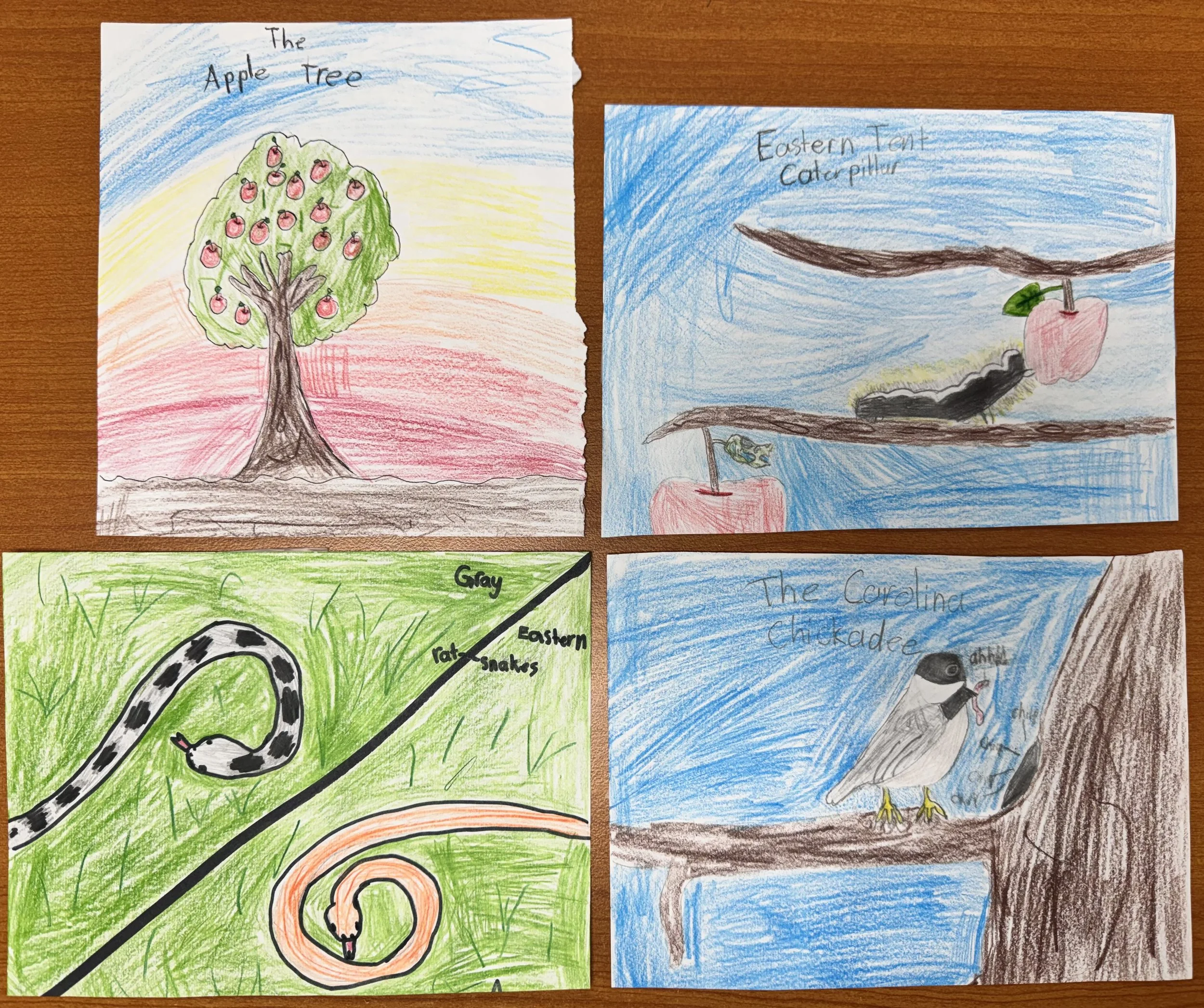
Nature is interesting and lots of things happen, like animals eating each other. In a food chain, there is always a producer, consumer, and decomposers. The producers produce food and are normally plants. Consumers eat the producers and other consumers. Decomposers break down dead plants and animals for food. This food chain is found in the southeast United States of America. The bottom of this food chain is the apple tree and the top of this food chain is the rat snake.
The apple tree is a producer. The apple tree grows, just like every living thing. The apple tree starts out as a seed. Next, the tree starts to grow into a sapling. It takes about five to ten years for the apple tree to grow to its full size. Small blossoms then begin to grow on the tree. The blossoms start out looking pink, then they turn yellow, and lastly they turn white. Within the blossom, there is a stamen. The stamen, or male part of the blossoms, produce pollen. The stamen has two parts, the filament and the anther. The anther is held up by the filament. The blossoms also have pistols. The pistol, or the female part, collects the pollen. The pistol has four parts, the style, the stigma, the ovule, or seeds, and the ovary. The style holds up the stigma, the ovary is the base of the style and holds the ovules. That's where the pollinators come in. Insects, like bees and butterflies, are pollinators. The pollinators land on the blossoms to drink the nectar inside. The pollen sticks to the pollinator’s legs and stomachs. They take pollen with them when they land and then move on to the next blossoms.The pollinators don’t purposely spread pollen, the plant sneaks that upon them. Once the blossom is pollinated, the blossom turns into the apple. It takes about six months for an apple to grow. Every plant, like the apple tree, uses photosynthesis in order to survive. Photosynthesis is how a plant makes its food, known as glucose, from the sun. There is leftover oxygen from the CO2 and the H2O molecules after making glucose. A plant takes in carbon dioxide and has left over oxygen for us, so that we humans can breathe in oxygen.The apple tree is a part of the rose family. The apple tree takes about four years to produce its first apple. An apple tree can produce up to 400 apples a year. Sometimes the apple tree dies of old age, 100 years old. Other times, the apple tree doesn't live a full life. The apple tree can get many diseases, like bitter rot and black rot. Bitter rot and black rot are both fungal diseases. These fungal diseases can make the apples rotten. Though there are many diseases to the apple tree, its leaves are still good to animals like leafrollers, green fruit worms, and even deer can eat those leaves, not just the eastern tent caterpillar.
The eastern tent caterpillar is a consumer. The eastern tent caterpillar starts out as an egg and stays in the egg for eighteen days. When it comes out of its egg, it then begins its life as a caterpillar for four to six weeks. The eastern tent caterpillar is black with a white line running along the middle of its back. They also have yellow tinted setaes, or hairs. This caterpillar does not only eat apple tree leaves, but cherry and cranapple leaves too. Did you know that a group of eastern tent caterpillars is called an army? There are up to a million caterpillars in an army. The eastern tent caterpillar can get from two to two and a half inches long. They have twelve eyes and they have six eyes on each side of their body. Fun fact, eastern tent caterpillars are distantly related to silk worms. The caterpillar crawls up a tree branch and hangs from its head and changes into the yellow-white cocoon for five to twenty one days. Then, it opens up and lets the moth out. When the moth comes out, the moth only lives for five days. These caterpillars are safe to touch. Robins, cuckoos, wasps, different types of amphibians and small mammals and the Carolina chickadee, eat the eastern tent caterpillar.
The Carolina chickadee is a consumer. The Carolina chickadee is a very curious and intelligent creature. This bird has a black head, grey wings and a tan stomach. The Carolina chickadee can get up to four to five inches tall and its wingspan can get as long as six to eight inches. A group of Carolina chickadees is called a bantitry. As the legend, from the Native American tradition, goes, the Carolina chickadee is said to bring good luck.This chickadee eats many things, like seeds, berries, spiders, insects and caterpillars. Domestic cats, woodpeckers, wrens, hawks, and owls all eat the Carolina chickadee. Do you know what else eats the Carolina chickadee? The rat snake consumes them too.
Rats snakes are consumers. They stay in their two inch, off-white egg for eight to ten weeks. If the snake is domesticated, then when the snake hatches, it can live up to twenty years. If the snake lives in the wild, then they can only live up to ten to fifteen years old. Some rat snakes are grey with darker grey patterns on their backs. These are called the grey rat snake. Other rat snakes are orange with darker orange lines on their backs in the direction of their spines. This snake is called the eastern rat snake. Grey rat snakes live in more shady areas, but the eastern rat snake lives in the more sunny areas. As a young rat snake, they are about ten inches long and as an adult, they can get up to six feet long. That is about as long as the height of a full grown man! Rat snakes do not have fangs. Instead, they have teeth that look like fangs. Since some snakes don’t have fangs, they also don't have venom. Some snakes don’t need venom in order to kill their prey These snakes are considered constrictors. Constrictor snakes wrap their bodies around their prey’s neck and that suffocates them. Some of their prey are birds, bird eggs, frogs, lizards and rats. The rat snake is the top of this food chain, but not the apex predator. Foxes, owls, raccoons, and hawks still eat the rat snakes.
There are many more food chains to learn about, not just this one. There are aquatic food chains, land food chains and sometimes even a combination of land and aquatic food chains. If one part of the food chain gets disrupted, then the whole food chain falls apart. For example, if you take the Carolina chickadee out, then the rat snake will go hungry and die. The eastern tent caterpillar will overpopulate, kill all the apple trees and then go hungry and die.
6th Grade Student